Federated continual learning breaks along two coupled axes: clients drift apart, then tasks overwrite one another. SUM regulates both at server aggregation with one geometric principle.
Abstract
Real-world intelligent systems often require both distributed collaboration across data-isolated clients and continual adaptation to evolving tasks. This setting naturally gives rise to Federated Class-Incremental Learning (FCIL), which combines Federated Learning (FL) and Continual Learning (CL). However, their combination introduces two coupled sources of interference: spatial interference from heterogeneous clients and temporal interference from sequential tasks, jointly leading to Spatial–Temporal Catastrophic Forgetting (ST-CF). Existing approaches typically address spatial and temporal interference with separate mechanisms, often incurring additional client-side computation or communication, while leaving directional interactions among updates during aggregation unregulated. In this paper, we reinterpret FCIL as a unified multi-task learning problem, where both client and task updates are represented as adaptation vectors in a shared parameter space. Based on this view, we propose Surgery & Merge (Sum), a purely server-side framework that performs geometric surgery on adaptation vectors during aggregation. Spatial Sum mitigates client-level interference within each round, while causal online temporal Sum removes cross-task interference over time without additional client-side computation, communication, or memory beyond standard federated training. Empirically, Sum achieves up to 22% improvement over prior FCIL methods across diverse vision and language benchmarks while remaining robust to unreliable clients and maintaining computational efficiency.
18 / 18best vision settings
up to 22%gain over prior FCIL methods
server-onlyno extra client-side cost
01
Motivation
Directional interactions decide what survives aggregation.
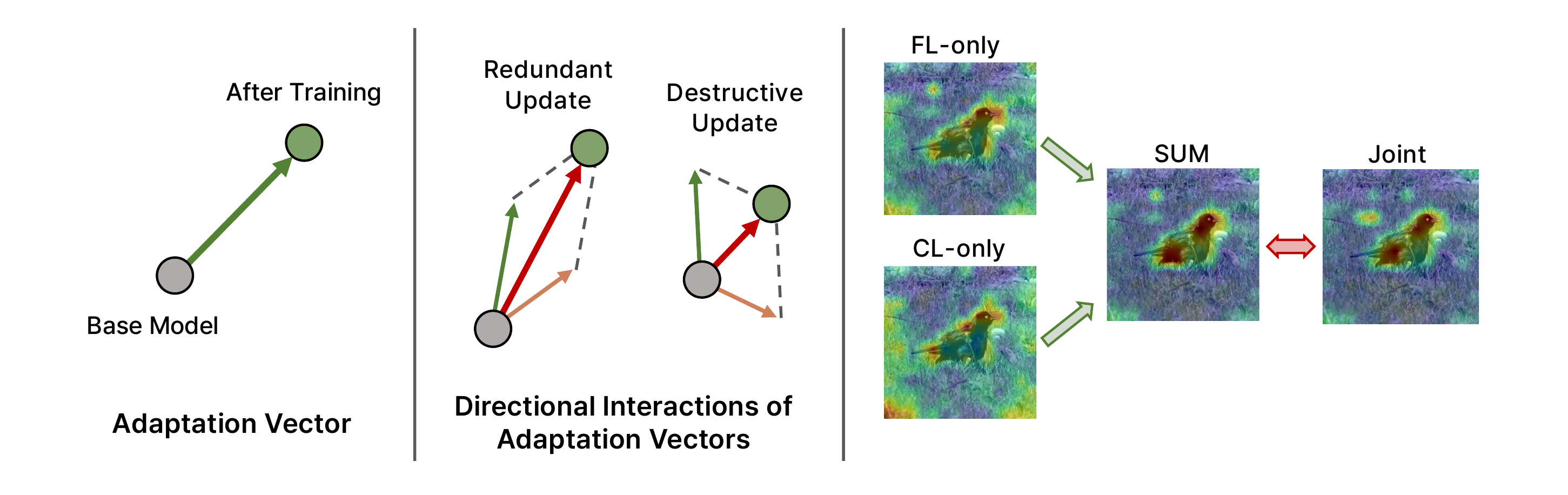
FCIL couples two failure modes: non-IID clients create spatial interference inside each communication round, while sequential tasks create temporal interference over the learning history. Treating them independently leaves residual interference on the other axis.
In the shared parameter space, both client and task updates act as adaptation vectors. Aligned components can repeat the same update; opposing components can erase useful knowledge. SUM therefore regulates their geometry at the point where those vectors actually meet: server aggregation.
Aggregation is not a passive average—it is the control point for what the global model retains.
02
Method
One surgery principle, applied across space and time.
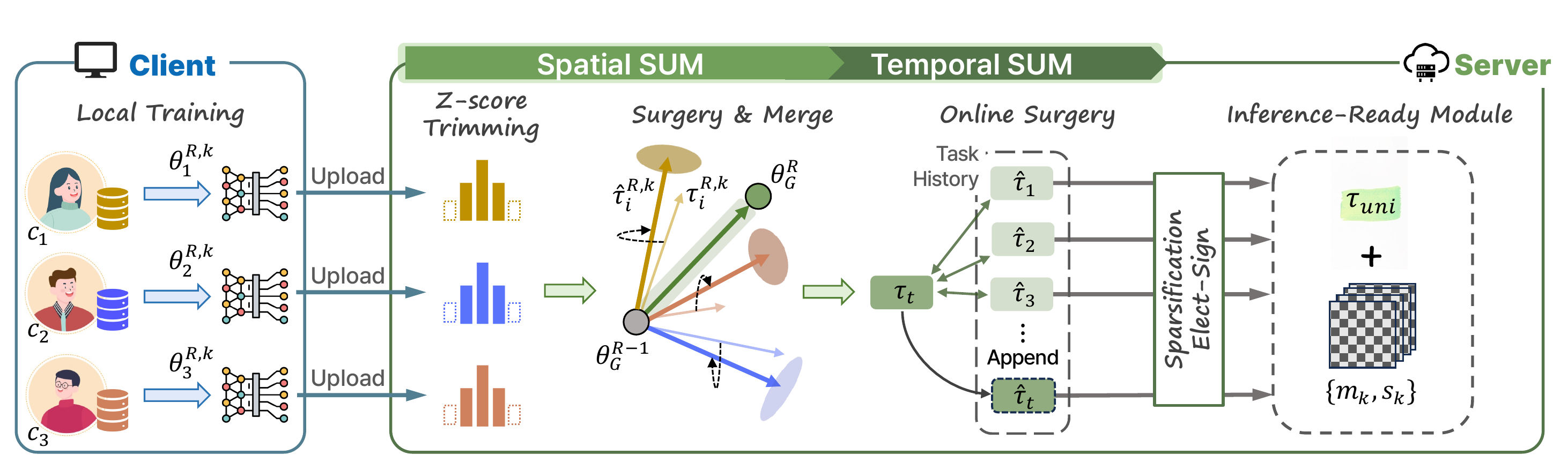
SUM keeps standard client training and parameter communication intact. The server first refines concurrent client updates within each round, then causally refines each completed task against the accumulated task history and stores a compact inference module.
Spatial SUM
Two-task lifecycleTask 1 · communication round 1 / 5
Task 1Spatial SUM every round
1R1
2R2
3R3
4R4
5R5
ΣSurgery
→
Task 2Spatial SUM every round
1R1
2R2
3R3
4R4
5R5
ΣSurgery
→
✓Inference ready
Spatial SUM regulates client interactions within every communication round.
Trim: Z-score statistics suppress extreme coordinates before vector comparison.
Surgery: pairwise projection removes redundant and destructive client-coupled components.
Merge: the server aggregates only refined residuals; local training and uploads remain unchanged.
Temporal SUM protects accumulated task knowledge at each task boundary.
Re-anchor: every accumulated task vector is expressed from the same pretrained model.
Causal surgery: the current task is projected only against previously refined task directions.
Append: the new refined vector joins the task history without revisiting past data.
The inference-ready module stores task identity without a full model copy.
Sparsify: retain the largest-magnitude coordinates of each refined task vector.
Elect-Sign: build one direction from coordinate-wise sign consensus and discard conflicts.
Activate: reconstruct each task with a binary mask and scalar over the unified direction.
03
Experiments
SUM leads across every evaluated vision setting.
Final Averaged Accuracy (FAA, ↑) under the same backbone, task split, client partition, communication rounds, and data-access constraints. Each dataset is evaluated at three levels of client heterogeneity.
Main quantitative results
Best values are highlighted.
Method
CIFAR-100
ImageNet-R
ImageNet-A
EuroSAT
CARS-196
CUB-200
.5
.1
.05
.5
.1
.05
1.0
.5
.2
1.0
.5
.2
1.0
.5
.2
1.0
.5
.2
Joint
92.75
84.02
54.64
98.42
85.62
86.04
EWC
78.46
72.42
64.51
58.93
48.15
43.68
10.86
10.07
8.89
64.12
59.30
56.52
19.55
18.02
18.29
31.46
29.60
27.89
LwF
62.87
55.56
47.09
54.03
41.02
46.07
8.89
8.89
7.90
31.91
21.26
31.42
20.84
22.72
31.76
25.25
21.11
18.54
FisherAvg
76.10
74.43
65.31
58.68
50.82
47.33
11.59
11.06
10.14
58.84
59.94
55.86
26.03
24.60
21.58
30.45
28.39
25.06
RegMean
59.80
45.88
39.08
61.18
57.00
55.80
8.56
6.22
4.34
48.74
51.73
45.27
21.83
20.36
15.92
35.57
32.84
32.83
CCVR
79.95
75.14
65.30
70.00
62.60
60.38
39.50
36.27
35.94
64.44
57.93
62.69
38.99
37.81
35.31
62.67
59.48
56.33
L2P
83.88
61.54
55.00
42.08
23.85
16.98
20.14
17.31
16.85
40.63
51.78
45.46
35.49
31.00
20.01
56.23
47.31
38.16
CODA-P
82.25
61.82
46.74
61.18
36.73
25.82
18.30
14.48
7.31
73.38
69.42
66.69
28.04
20.83
14.53
42.53
37.71
29.19
FedProto
75.79
70.02
60.55
58.52
47.30
52.93
9.87
9.22
10.01
58.79
62.85
64.17
26.08
24.55
22.75
30.22
28.27
26.01
TARGET
74.72
72.32
62.60
54.65
45.83
41.32
10.27
11.39
10.73
52.74
52.74
45.11
28.65
27.20
26.13
39.30
38.40
34.79
PILoRA
76.48
75.81
74.80
53.67
51.62
49.37
19.62
18.70
20.01
48.35
32.89
31.22
37.57
37.92
36.95
61.11
60.68
60.39
FOT
79.26
76.45
69.89
68.65
59.92
55.12
18.37
17.25
15.01
59.58
57.07
48.07
33.53
33.49
30.57
45.88
41.78
41.28
LoRM
86.95
81.75
82.76
72.48
63.83
66.45
37.26
36.34
33.11
84.23
77.26
81.36
54.41
51.87
48.81
64.60
63.67
60.06
SUM
97.03
96.93
96.32
83.80
85.58
86.81
49.90
50.82
47.86
96.51
93.28
98.57
68.78
68.83
67.57
81.69
79.79
79.43
Learning dynamics
Fast adaptation without progressive forgetting.
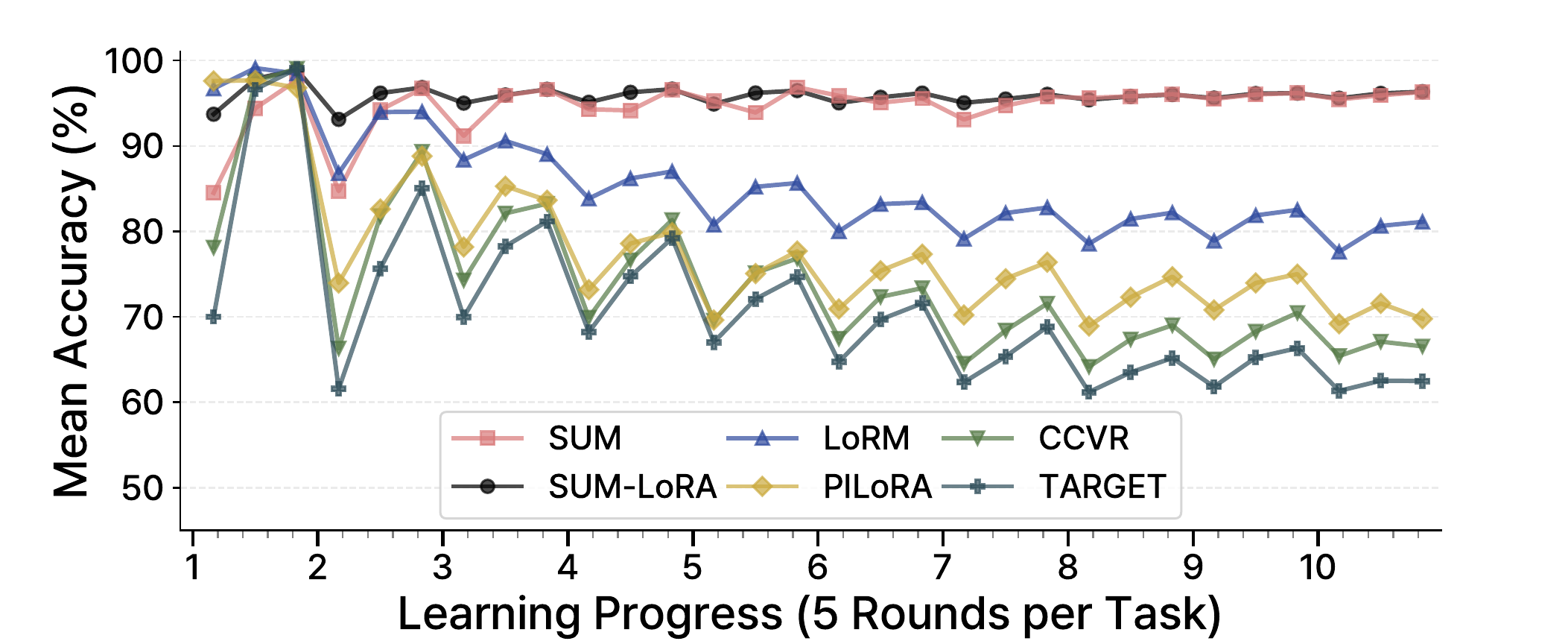
Across FCIL baselines, each task begins with a pronounced V-shaped drop before the model recovers over the five communication rounds. Their task-end accuracy also declines as more tasks arrive, revealing accumulated catastrophic forgetting.
SUM shows a much shallower within-task V-shape and maintains a nearly flat task-end envelope. Spatial surgery stabilizes adaptation inside each task, while temporal surgery preserves what earlier tasks contributed.
The curve separates two effects: faster recovery within tasks and stronger retention across tasks.
04
Analysis
Every stage contributes—and SUM scales smoothly.
Removing spatial surgery produces the largest drop, but every component contributes to the final result. The ablation isolates trimming, spatial and temporal refinement, sparsification, sign election, and mask-based modularization under the same CIFAR-100 setting.
Component ablation
CIFAR-100, β = 0.05
Module
Ablation setting
FAA ↑
Δ
Wall time
Spatial SUM
w/o Z-score Trimming
85.87
−10.45
1.00×
w/o Spatial Surgery
78.93
−17.39
0.77×
Temporal SUM
w/o Temporal Surgery
87.67
−8.65
0.90×
Inference-ready
w/o Sparsification
90.23
−6.09
0.92×
w/o Elect-Sign
94.58
−1.74
0.93×
w/o Mask Modular
91.24
−5.08
1.00×
SUM
Full method
96.32
—
1.00×
Surgery target & scalability
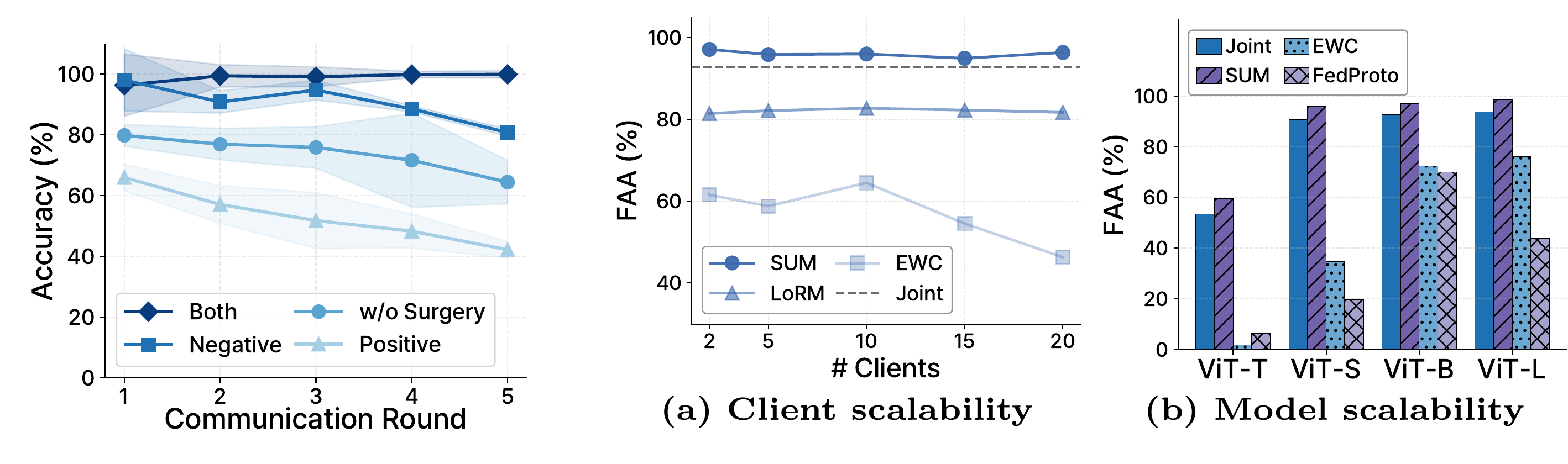
Bidirectional surgery is consistently stronger than removing only positive or only negative interactions: redundant and destructive components must be handled together. The gain also survives deployment-scale changes. As the number of clients grows, SUM remains near or above Joint while EWC degrades and LoRM plateaus; as ViT size increases from Tiny to Large, SUM continues to scale and stays ahead of the centralized reference. These trends indicate that the improvement is not tied to one client count or one backbone capacity.
BibTeX
@article{kim2026sum,
  title   = {SUM: Unified Geometric Surgery on Spatio-Temporal Adaptation Vectors for Federated Class-Incremental Learning},
  author  = {Kim, Jaeik and Do, Jaeyoung},
  journal = {arXiv preprint arXiv:2607.19384},
  year    = {2026}
}